"I imagine there must be only a very, very few men in the world, that I should like to marry; and of those few, it is ten to one I may never be acquainted with one; or if I should, it is twenty to one he may not happen to be single, or to take a fancy to me."

I first discovered the Brontë sisters when I was sixteen. I had finished my GCSEs, and knew that I wanted to spend the summer between then and A-Levels reading. I read The Great Gatsby (a disappointment to younger Luke, although I would be interested to see if I would like it more now, almost ten years on!), followed by re-reading The Bell Jar (a book I had read the previous year by my wonderful English teacher) and To Kill a Mockingbird. Then, as I was looking on my bookshelves, I found my copy of Jane Eyre. I knew a little bit about the story, and had heard of the Brontës (well, Charlotte and Emily.) So I decided to give it a go.
Fast forward to 2026. I had read, spread out over the years, Jane Eyre, Wuthering Heights and Agnes Grey, enjoying all three greatly. A trip to Haworth for my birthday had inspired a desire to read another book from the Brontës: the only question was, which book do I go for next?
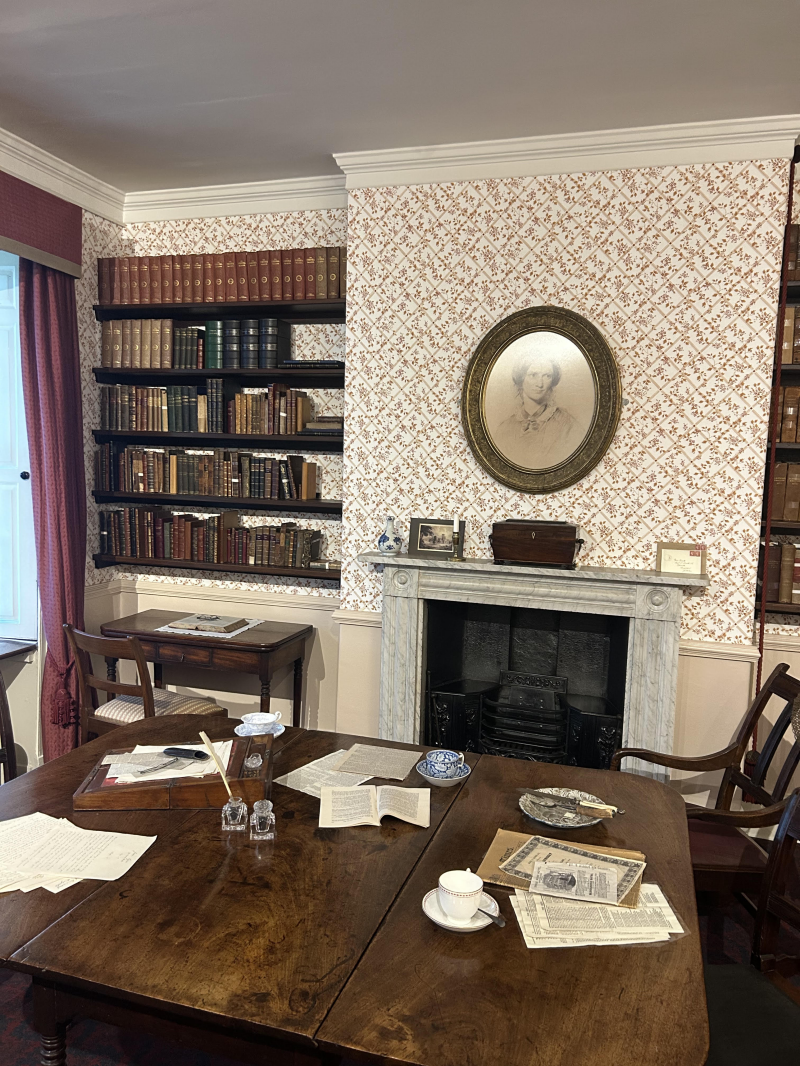
The parlour of the Brontë parsonage, where the three sisters wrote their stories. Emily even scratched the letter 'E' into this table!
I was torn between two novels: Charlotte's Villette, and Anne's The Tenant of Wildfell Hall. I am very glad, though, that I chose to go with Anne's story.
The Tenant of Wildfell Hall focuses on the story of Helen, a mysterious woman who arrives one day at Wildfell Hall with her young son. But where is her husband? That is what the townsfolk want to know. Interestingly, rather than have Helen be the narrator, we are told most of the story from the perspective of one of these townsfolk: Gilbert Markman. He quickly strikes a friendship with Helen, even though she still remains aloof and is clearly hiding something about her past from Markman.
As the story develops, we then discover why Helen arrived at Wildfell Hall. She is in exile, having fled from an awful relationship with an alcoholic, cruel man. Of course, this is a novel of a time where women were the property of men, so we see a great struggle in Helen, between independence and loyalty to her marriage, and therefore husband.
The story does end on a more uplifting note; Helen is freed (eventually) from the constraints of her previous marriage, Markman (of course) falls in love with Helen and the two do, at the novel's conclusion, begin a new life together as husband and wife.
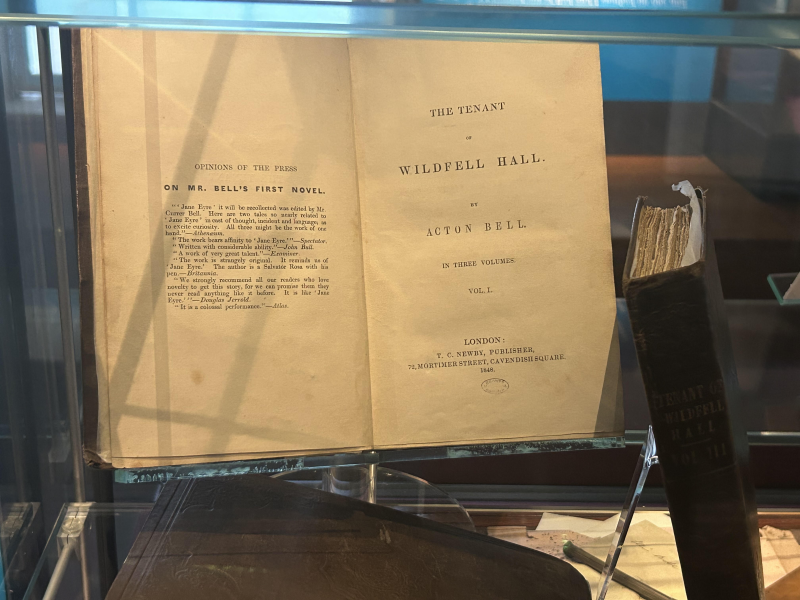
A copy of Volume One of The Tenant of Wildfell Hall, on display at the Brontë parsonage.
This book, in my opinion, is the best of the Brontë's works (that I have read thus far.) I think it is worthy of more recognition than it perhaps gets, especially when we consider how renowned Jane Eyre and Wuthering Heights are. Anne seems to be a bit side-lined in comparison to her sisters, but this story tackles difficult themes with a real sense of compassion. I truly felt for Helen in the story, and I really liked how she stuck to her principles, even if I knew that was going to cause her further misery. If I am being honest, I was less interested when we were with Markman, and so the section of the story where we were reading Helen's diary was where I was most into the story.
The other element which stood out to me was the story's powerful feminist voice. It critiques the unequal positions of men and women in society, with Anne using Helen's transgression from expected models of behaviour as a means of advocating for female agency. There's a greater sense of independence as well; Helen works, manages property and defends herself and her decisions in a moral and literal sense. This distinguishes her from Jane and Catherine her sisters wrote, and thus represents, in my opinion, a more direct feminist lens than that seen in Jane Eyre and Wuthering Heights.
I also learnt, after reading the book and doing some reading around the book, that Anne, in the preface to the second edition of her novel, purported the view that men and women should both read novels and women's writing was something to be defended, rather than attacked.
Overall, I thoroughly enjoyed my time with this novel. Anne has now become my favourite of the Brontë sisters. I am sad to have read everything by her (the only problem with the Brontës, unfortunately!). I wonder how long it will be until my next Brontë book; I feel like it will most definitely be Villette ...
Create Your Own Website With Webador