Grammar. It is, arguably, one of the most contentious parts of the English Curriculum. So much so, I decided to write my Master's dissertation on the teaching of grammar in secondary schools. In particular, I chose to focus my research on supporting pupils who were (at the time of conducting the research) eligible for Pupil Premium, and their feelings and confidence towards a closely related part of the English curriculum: creative writing.
In 2023, the Department for Education recorded that just 25% of pupils eligible for Pupil Premium attained a Grade 5 or above in GCSE English and Mathematics; for those not eligible for this government funding, this figure rose to 53% (Department for Education, 2023.) While there is a clear need to ensure that this attainment gap is closed, writing pedagogy, in particular, that relating to grammar instruction, remains a point of critical tension.
To begin with, the very definition of grammar itself is built on an amalgamation of ideas relating to prescriptivism, that being fixed rules about what is and is not grammatical (Depraetere and Langford, 2012) and semiotic relationships with language itself, wherein we 'describe language at various levels to aid interpretation' (Halliday, 1967). One only has to look at the Oxford English Dictionary's definition of grammar to see ideas concerning:
- The area of study concerned with the structure of a language or of languages in general.
- An account of the structures or rules of language or of a language in general.
- Knowledge or usage of language [...] according to how it conforms to prescriptive rules of grammar (Oxford English Dictionary, 2024.)
Acknowledging this nuance in grammar's definition is crucial if we wish to explore the impact of grammar teaching in the secondary English classroom. Focusing too much on the "what" of grammar (labelling various words, phrases and clauses), without consideration of the "why", prevents grammar from becoming what Myhill et al. (2012) describe as 'an enabling element in writing development' (p. 162). We must always ensure that metalinguistic knowledge (the "what") is balanced with consideration of the "why" in order to help pupils develop their knowledge of how they can craft their own pieces of writing.
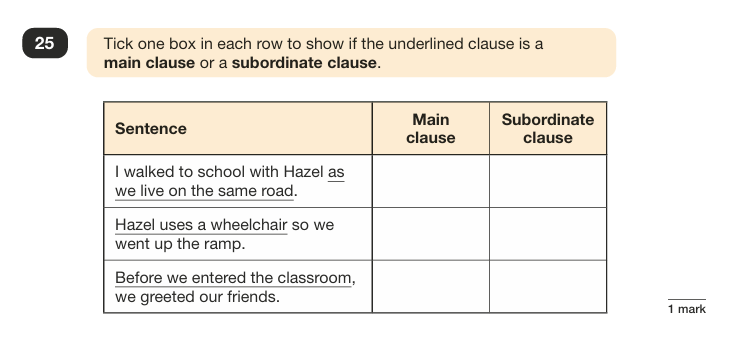
Appendix: Department for Education (2025). Key Stage Two English Grammar, Punctuation and Spelling Paper One: Questions, Question 2025.https://assets.publishing.service.gov.uk/media/682dbbc6baff3dab99775152/2025_KS2_English_GPS_Paper1_questions.pdf
If we are asking Year Six pupils to merely tick a box and say whether a clause is main or subordinate, how are we setting them up for success in Key Stage Three, where grammar is not assessed like this whatsoever?
If we want pupils to know what a subordinate clause is, we must then ensure that they know how to - and then have the opportunity to - apply this, explicitly, to their own writing (Willingham, 2008). Doing so allows pupils to see the meaning behind deliberate choices made with grammar, something which is referred to as contextualised grammar teaching (see Myhill et al., 2012).
But even if we approach grammar in a contextualised way, we must ensure that findings provide evidence of a significant impact on pupils' outcomes, which data from those such as Myhill et al. (2012) did not. Their effect size of 0.33, despite showing some positive impact on the writing of those who participated in the research, falls bellow the benchmark required for what Hattie (2009) declares to be meaningful educational change. We must also ensure that we use authentic texts when approaching grammar, to expose pupils to ways in which grammatical models are used and changed to create meaning (Myhill, 2018).
Taking this into consideration, it was decided that two Year Seven classes, of a cohort who were almost 60% eligible for Pupil Premium, would be the focus of the research. Using Zana Fraillon's The Bone Sparrow as our authentic text, we set about seeing whether contextualised grammar teaching would have an impact on the feelings and confidence of those eligible for Pupil Premium, and what exactly these feelings would be.
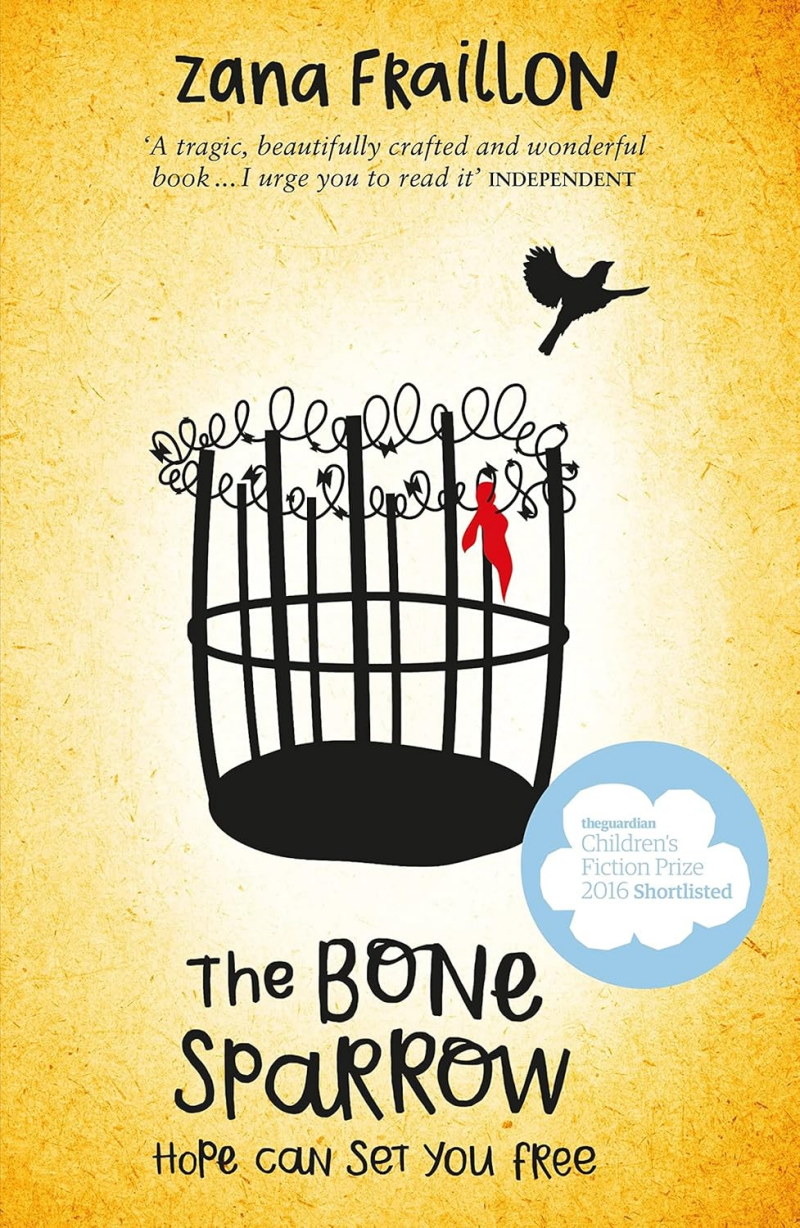
Fraillon's The Bone Sparrow.
If you have not read this book before, it is a beautiful story about two children: one who is a Rohingya refugee and one who lives with her father and brother in Australia. Its raw, doesn't shy away from darker moments, and the pupils loved it!
The intervention saw us reading the novel at speed, enjoying the story and developing our reading skills alongside the more targeted lessons where metalinguistic knowledge was prioritised. This ensured that pupils would develop the skills required to decode a text and understand the meanings being created (Zheng et al., 2023).
During these more focused lessons, we would begin by retrieving and consolidating grammatical knowledge which was relevant to the extract we would be looking at. This ensured that the grammatical terms being used were purposeful, and that pupils could then see in subsequent tasks how we were using that to work out the meaning of a text.
Following on from this, we would look at an extract from The Bone Sparrow. To reduce cognitive overload, this was an extract which has been read previously in class, and questioning strategies were used to ensure that all pupils knew exactly what was going on in the extract. After re-reading the extract, pupils had an opportunity to identify anything which they thought was interesting: a particular word, a phrase. They were reminded that it was more important for them to talk about the effect of what they were talking about, rather than using the precise grammatical terms; 'noun' or even 'the word' was better than deliberating whether it was an abstract or a concrete noun. We would then feedback, adding to our annotations and ideas.
The final tasks would focus on pupils applying their knowledge of what the writer was doing in the extract to a task with a similar focus. For example, we looked at one extract where Subhi, the protagonist, is describing a feeling that something bad is going to happen; in turn, pupils then had a go at writing their own pieces where they felt that something bad was going to happen to them. Suggestions were put on the board to help them: something in school, at home, whilst they were out with friends. After a period of writing, pupils then reflected on what they had written and had a go at explaining, in the form of a commentary, the grammatical choices they had made in their writing.
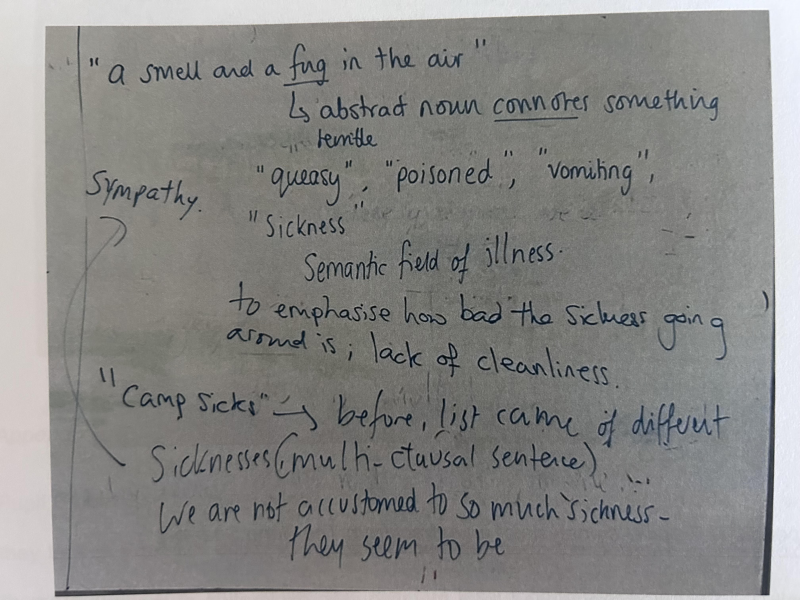
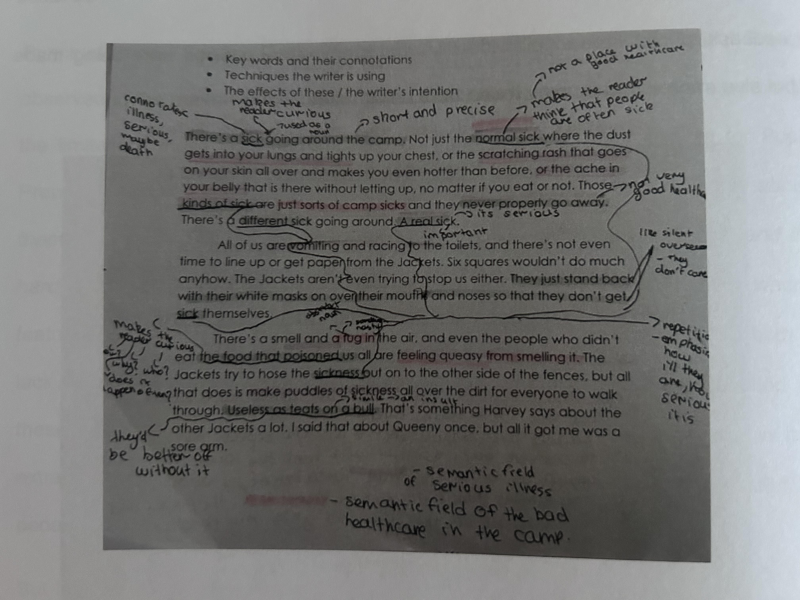
Appendix: An example of some of the work completed by the Year Seven pupils taking part in the research.
The results from this research (which included classroom observations, interviews with pupils and a Critical Friend to look over and question the data I had collected) made three things clear:
- Grammar instruction must be centred around functional analysis. Whilst there is a notion of accuracy at play if a pupil mistakenly identifies a noun as a verb, a pupil's ability to explain and analyse the effects of that word and why it was used is far more important. This in turn, for some of the pupils eligible for Pupil Premium, resulted in them producing more purposeful and thoughtful creative writing.
- For all pupils, but particularly for those who are eligible for Pupil Premium, repeated opportunities to practise their creative writing is essential. Whilst not every pupil eligible for Pupil Premium reported that they were beginning to feel more confident about their creative writing, it was noted that some appeared to flourish, something which they then confirmed in final interviews, reporting that now they have a better understanding of how they could achieve an effect in their writing - "knowing what to do", to quote one student - they felt that a barrier to learning had been removed.
- Further research is needed into specific groups of pupils eligible for Pupil Premium. As this group of pupils contains pupils who may have just become eligible for Pupil Premium, those who have additional needs, or English as an Additional Language (to name a few), and due to time constraints of the research, the data collected did not account for the full range of differences that can appear in these pupils. Indeed, some pupils eligible for Pupil Premium reported lower levels of confidence and feeling more overwhelmed about creative writing after the intervention. It is clear, therefore, that additional interventions tailored more specifically to the needs of these pupils, is needed to ascertain whether or not this pedagogical approach is beneficial for these pupils.
Overall, whilst limitations exist, the research project highlighted the potential positives benefits of incorporating contextualised grammar teaching into writing pedagogy for those eligible for Pupil Premium. The findings offered a secure foundation for future research and it was an enriching experience for myself. Not only has it improved my own teaching practice, it has also helped me be aware of how I support my pupils in my classroom and ensure that all have access to an equitable learning experience.
Bibliography
Department for Education (2023). Key Stage Four Performance: Academic Year 2022/23.
Depraetere, I; Langford, C. (2012). Advanced English Grammar: A Linguistic Approach. London: Bloomsbury Academic.
Halliday, M. (1967). 'Linguistics and the Teaching of English', in Britton, J. (1973). Handbook for English Teachers 2: Talking and Writing. Methuen.
Myhill, D. A. (2018) 'Grammar as a Meaning-Making Resource for Improving Writing.' L1 - Educational Studies in Language and Literature, Vol. 18, No. 1. 1 -21.
Myhill, D.; Jones, S.; Lines, H.; Watson, A. (2012). 'Re-thinking Grammar: The Impact of Embedded Grammar Teaching on Students' Writing and Students' Metalinguistic Understanding.' Research Papers in Education, Vol. 27, No. 2. 139 - 166.
Oxford English Dictionary (2024). Grammar: Definition. https://www.oed.com/dictionary/grammar_n?tab=meaning_and_use#2658225
Willingham, D. T. (2008) 'What Will Improve a Student's Memory?'. American Educator, Winter 2008 - 2009. 17 - 41.
Zheng, H.; Miao, X.; Dong, Y.; Yuan, D. C. (2023). 'The Relationship Between Grammatical Knowledge and Reading Comprehension: A Metanalysis.' Frontiers in Psychology, 14. https://doi.org/10.3389/fpsyg.202.1098568
Add comment
Comments